KSJ-160 vs ZSJ-III Paper Cup Machine – Speed vs Value?
May 29,2026
When a buyer from a mid‑sized packaging company called me with a dilemma that sounded all too familiar—“Should I go for maximum output or a more affordable machine?”—I realized this question isn’t just about numbers on a spec sheet. It’s about your entire production strategy, your cash flow, and where you see your business in three years.
Let’s be honest: the forming equipment market has become a battlefield of bold claims. On one side, speed demons promise sky‑high output. On the other hand, value propositions focus on lower upfront costs. But here’s what sales brochures rarely tell you: the true cost of a machine isn’t what you pay today—it’s what you spend over the next five years on energy, maintenance, downtime, and labor.
Today, we’re breaking down two popular contenders: the high‑speed KSJ‑160 and the mid‑range ZSJ‑III. No marketing fluff. No hidden agendas. Just real specs, real operational considerations, and a decision framework you can actually use.
Understanding the Two Contenders
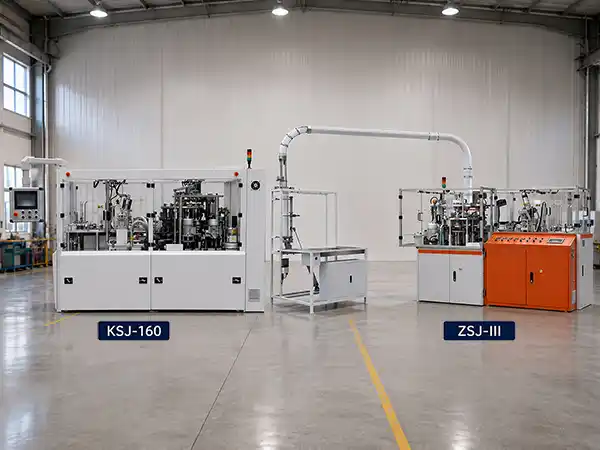
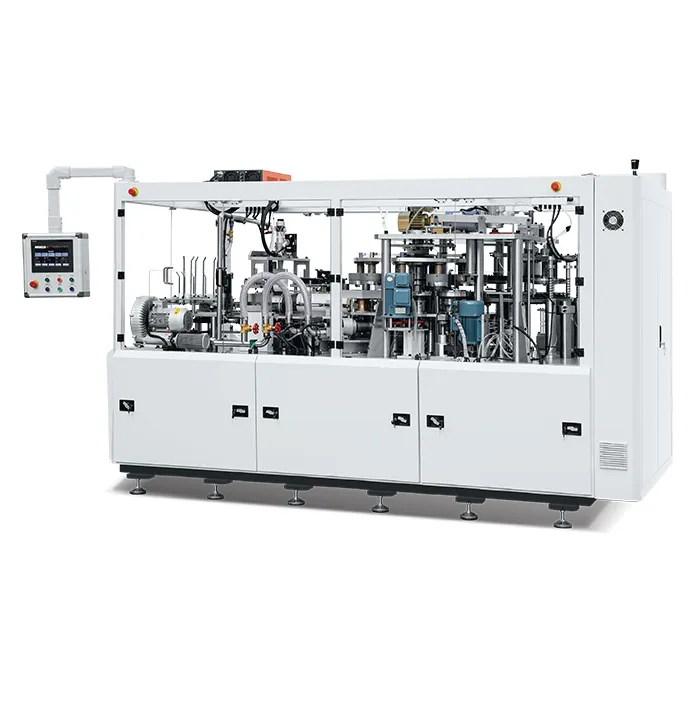
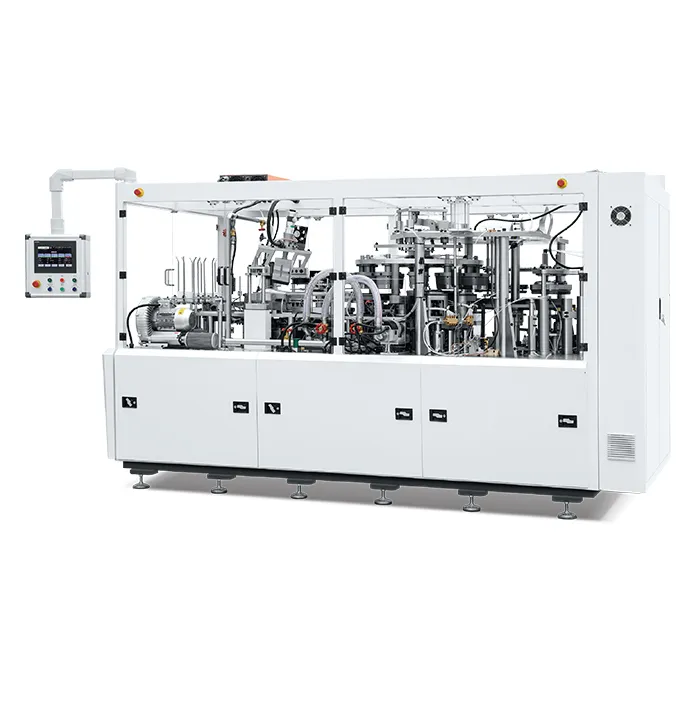
KSJ‑160 is positioned as a high‑performance automatic cup forming system. According to manufacturer documentation, it operates at a stable production speed of 140–160 cups per minute, employing an open‑type double‑cam drive system and high‑grade electrical components from Mitsubishi, Siemens, Omron, and Leister. Some sources have reported peak speeds reaching up to 180 cups per minute. The machine handles single‑ and double‑sided PE‑coated paper and produces a variety of cup types—hot and cold beverage cups, coffee cups, ice cream cups, and other food paper containers.
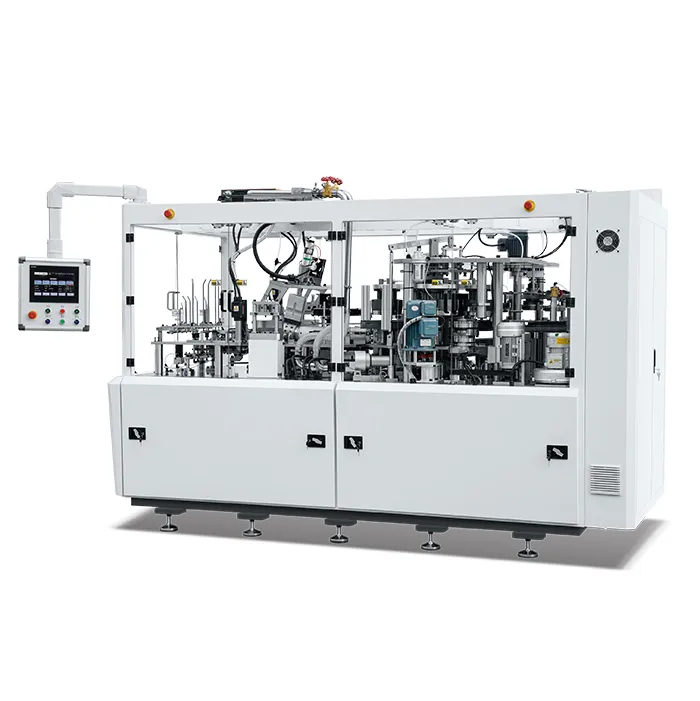
ZSJ‑III, in contrast, is a medium‑speed automatic forming system designed for businesses that prioritize operational flexibility and lower capital expenditure. Its production capacity ranges from 80 to 120 cups per minute, typically supporting cup sizes from 4 oz up to 22 oz depending on configuration. Like its faster sibling, it processes single‑ and double‑sided PE‑coated paper and can be equipped with optional blank conveying belts to reduce manual feeding frequency and labor costs.
These two machines come from the same manufacturing heritage but serve fundamentally different production philosophies. Let’s break down where they differ—and why that matters for your bottom line.
Speed vs. Stability
KSJ‑160 delivers raw output. At 140–160 cups per minute, it produces approximately 8,400 to 9,600 cups per hour. Over a single 8‑hour shift, that’s roughly 67,000 to 77,000 cups. If you’re supplying national coffee chains or handling large contracts, that throughput makes sense.
But here’s the catch: high‑speed systems demand more from your operators and your upstream processes. Paper feeding must be consistent. Material quality needs tighter control. And when something goes wrong at 160 cpm, it goes wrong fast.
ZSJ‑III trades top speed for operational flexibility. At 80–120 cups per minute, it gives you about 25–40% less daily output than the KSJ‑160. However, that lower speed means longer response windows for adjustments, less wear on mechanical components, and lower stress on your operators.
According to industry data, mid‑speed cup forming systems captured 45.39% of the global market share in 2025, reflecting strong demand for balanced solutions that avoid the higher maintenance burden of ultra‑fast machines.
The key insight: speed is only valuable if you can sustain it.
Hardware and Build Quality
Both machines use gear transmission systems. However, the KSJ‑160 benefits from more premium component sourcing—Mitsubishi, Siemens, Omron, and Leister components are standard. These global‑brand parts typically offer better reliability, longer service intervals, and easier replacement availability.
The ZSJ‑III uses more standard industrial components. While this keeps upfront costs lower, it also means shorter mean time between failures (MTBF) in continuous high‑volume operation. If you’re running three shifts, the component quality gap becomes meaningful.
There’s also the mold and tooling consideration. The KSJ‑160’s higher speed requires tool‑steel molds with tighter tolerances to maintain cup quality at peak output. The ZSJ‑III’s moderate speed tolerates slightly less expensive tooling—though premium molds still improve output quality regardless of machine speed.
A recent engineering analysis noted that “low‑speed machines (45 cpm) require one operator per unit, while high‑speed intelligent machines (120+ cpm) allow one operator to manage 3–4 machines thanks to auto‑stop sensors and visual fault detection”. This labor productivity gap compounds over time.
Automation and Configuration
The KSJ‑160 is equipped with an intelligent control system that includes automatic fault detection, real‑time production monitoring, and integration capabilities for upstream blank-feeding conveyors. These features reduce the need for constant operator attention.
Fully automatic systems are projected to hold a dominant 52.4% revenue share in the forming equipment market by 2025, driven by demand for reduced human intervention and improved product hygiene.
The ZSJ‑III can be configured with similar automation features—including automatic paper feeding and bottom sealing—but typically at a more basic level. The trade‑off is lower complexity and easier troubleshooting when things go wrong.
One often overlooked factor: changeover time. If you produce multiple cup sizes, the ZSJ‑III’s simpler mechanical design may allow faster mold changes and easier adjustment. The KSJ‑160’s high‑speed precision components require more careful calibration during changeovers—meaning more downtime if you frequently switch cup sizes.
Total Cost of Ownership and ROI
Let’s talk money. Industry pricing for mid‑speed automatic forming systems generally ranges from 8,000to8,000to18,000 per set, with molds costing approximately $1,300 additional. High‑speed systems like the KSJ‑160 command a significant premium—often 40–60% higher—driven by premium components, tighter manufacturing tolerances, and higher demand.
But upfront price isn’t the whole story. A thorough TCO analysis must consider:
Cost Factor
KSJ‑160 (High‑Speed)
ZSJ‑III (Mid‑Speed)
Upfront price
Higher
Lower
Per‑cup energy cost
Lower
Higher per cup
Maintenance frequency
Lower
Higher
Labor per 100k cups
Lower
Higher
Downtime cost per event
Higher
Lower
Mold cost
Higher
Lower
Data sources: Industry pricing benchmarks and component analysis
The ROI breakeven point depends entirely on your production volume. If you’re running 16 hours a day, six days a week, the KSJ‑160’s higher throughput will pay back its premium faster. If you run single shifts or variable schedules, the ZSJ‑III’s lower entry cost and simpler maintenance may deliver better returns.
Experienced buyers often apply the “80% rule”: never run a machine at its max rated speed. “If you need to produce 100 cups/min, buy a system rated for 120–140 cpm. Run it at 80% capacity for maximum longevity and stability”. For the KSJ‑160, sustained operation at 112–128 cpm is realistic. For the ZSJ‑III, that means 64–96 cpm—closing the gap between the two machines more than the headline numbers suggest.
The Real‑World Decision Framework
After analyzing these machines and speaking with production managers who operate both types, here’s the decision matrix I recommend:
Choose the high‑speed KSJ‑160 if:
You run multiple shifts
Your monthly cup volume exceeds 1.5 million units
You have trained technicians for maintenance
Your production mix includes only 1–2 cup sizes
You can afford the higher upfront investment
You serve clients with large, recurring orders
Choose the mid‑speed ZSJ‑III if:
You run single shifts or variable schedules
Your monthly volume is under 800,000 units
You’re a first‑time buyer with limited technical staff
You need flexibility to produce multiple cup sizes
Upfront capital is a constraint
You’re building a business and want to scale gradually
One production manager I spoke with put it bluntly: “The fastest machine in the world is worthless if your team can’t keep it running. I’d rather have 90% uptime at 100 cups per minute than 70% uptime at 160 cups per minute.”
Making Your Final Decision
Both the KSJ‑160 and ZSJ‑III are solid forming systems. Neither is “better” in absolute terms—the right choice depends entirely on your production volume, operator skill level, and growth trajectory.
Speed machines sell on promises. Value machines sell on results. Before you sign any purchase order, run your own TCO calculation using real numbers from your operations—your shift hours, your labor rates, your energy costs, your maintenance capacity. The machine that wins on paper is rarely the one with the biggest speed number. It’s the one that stays running when you need it most.
Disclaimer: Specifications and performance data presented in this article are based on publicly available manufacturer documentation and industry benchmarks as of May 2026. Actual machine performance may vary depending on operating conditions, material quality, and maintenance practices.
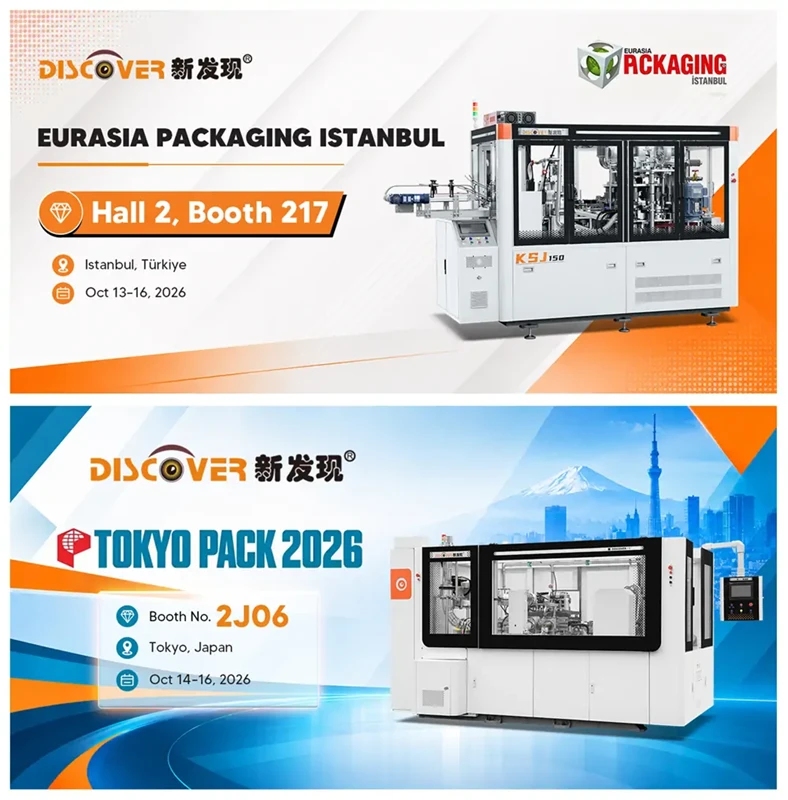
Golden October brings together grand industry events. Zhejiang New Discovery Machinery will make simultaneous appearances at four major domestic and international exhibitions: Eurasia Packaging Istanb
Zhejiang Discover Machinery Manufacturing Co., Ltd. is a premier manufacturer with 27 years of experience, specializing in high-precision machinery for diverse applications. Certified with CE, ISO, SA8000, and more, we offer innovative solutions, 60+ export countries, and a robust production capacity of 100 units monthly. Discover our advanced technology, quality assurance, and global expertise.
Noise and vibration in paper cup production are often treated as unavoidable operating conditions. In reality, both are measurable indicators of equipment condition, and excessive levels can affect op
Quality defects in paper cup production rarely have a single cause. The same symptom—a leaking bottom or a deformed rim—can originate from material variation, tooling wear, parameter drift, or mechani
Our paper cup machine service is supported by a dedicated team of professionals, from providing pre-sales advice and customizing machines to meet specific production requirements, to providing ongoing post-sales support and guidance.
Genuine parts ensure long-term availability
Seamless installation by technicians
Digital back-office management and compatible systems
Products and solutions to support a wide range of production needs
Exhibitions
We value your privacy
We use cookies to provide you with a better online experience, analyse and measure website usage, and assist in our marketing efforts.

 English
 Pусский
 عربي
عربي