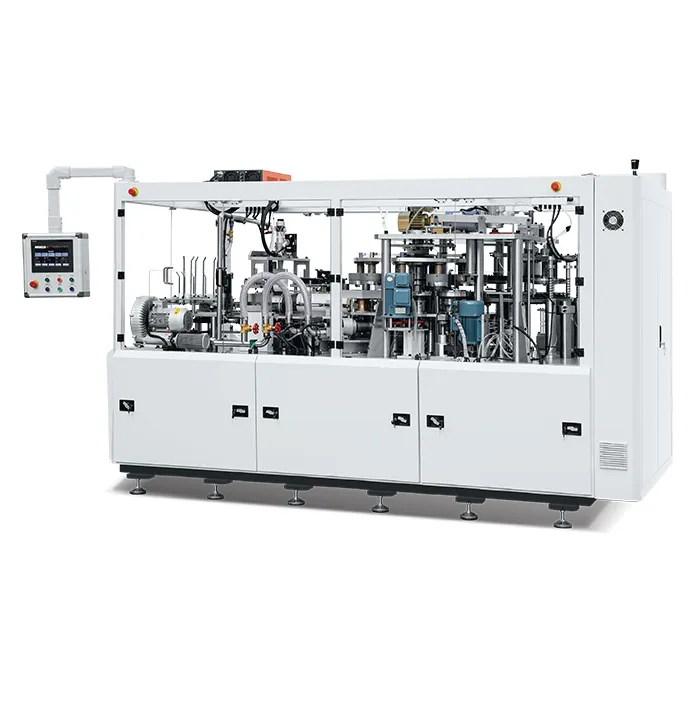
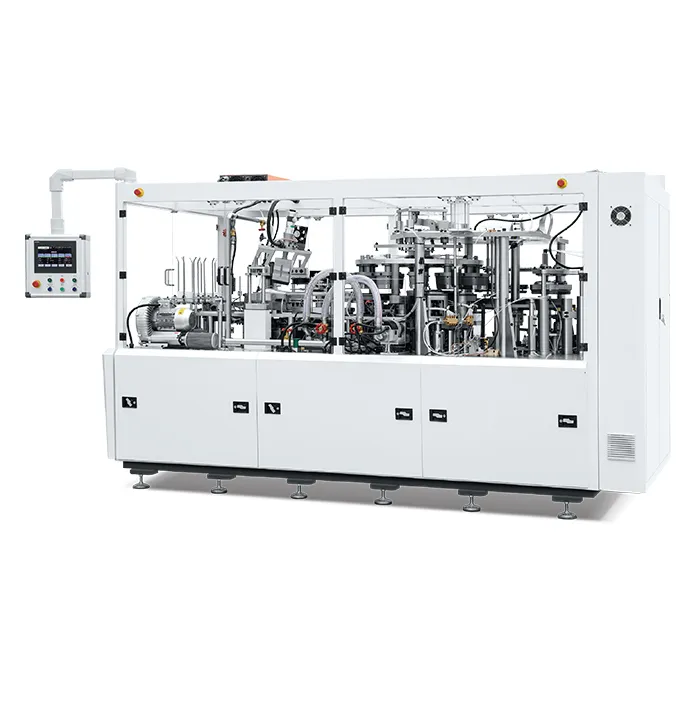
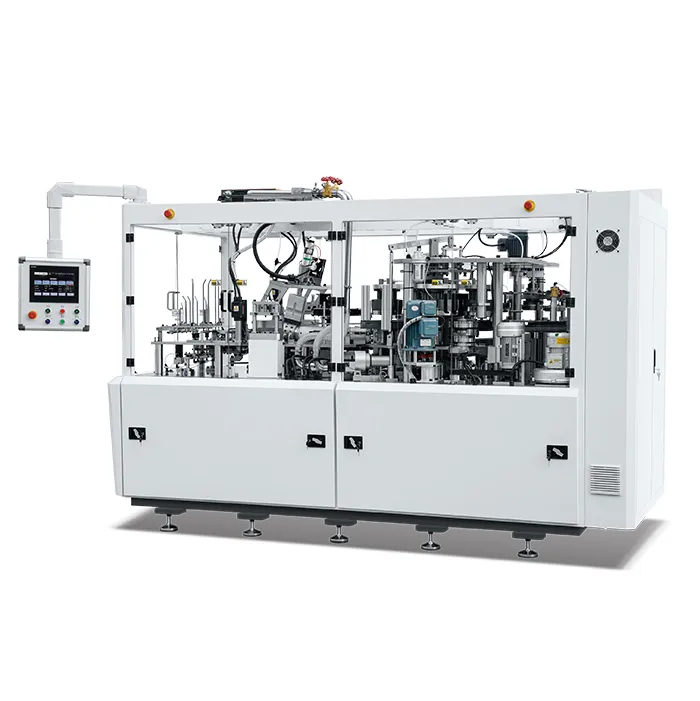
On a conventional cup-forming line, an operator who notices a slight variation in rim curl or bottom seal quality must stop the machine, make a mechanical adjustment, run a few test cups, and restart production. Each adjustment cycle takes minutes, and during that time the machine is producing nothing. Over the course of a shift, several such adjustments add up to a significant loss of output—and the cups produced between the onset of the defect and the operator’s intervention are often wasted. An intelligent Paper Cup Machine addresses this cycle of detect‑adjust‑restart by embedding the adjustment logic into the machine control system and by detecting quality deviations the moment they occur.
The intelligence in a modern cup-forming line comes from two integrated systems: a PLC (Programmable Logic Controller) that centralises all machine settings and servo commands, and an array of automatic detection sensors that monitor cup quality in real time. Together, these systems reduce the reliance on operator judgment for routine adjustments and create a production environment where deviations are caught and corrected before they produce scrap.
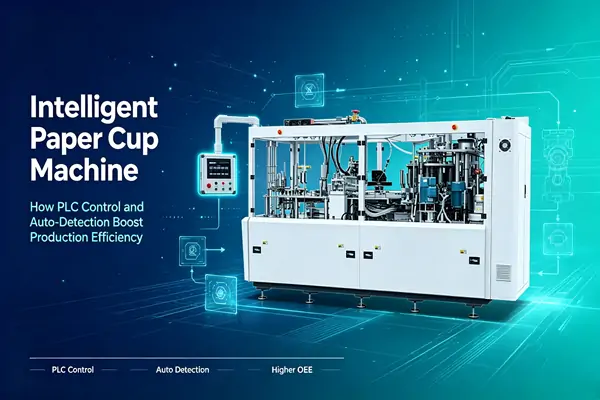
Centralised Control: One PLC Replaces Multiple Manual Adjustments
A traditional cup-forming machine has several mechanical adjustment points: the bottom heater temperature, the sealing pressure, the rim curling die position, the side seam alignment, and the cup discharge timing. Each of these is typically set by hand and may drift over a shift due to thermal expansion, vibration, or material batch variation. An operator who manages three or four machines simultaneously may not notice a slow drift until the cups begin to fail a leak test.
A PLC-controlled machine consolidates all of these parameters into a single touchscreen interface. The operator sets the cup size, paper grammage, and target speed, and the PLC calculates and applies the corresponding heater temperature, sealing pressure, and timing values. If the paper thickness varies between batches—from 210 gsm to 350 gsm, for example—the operator selects the stored recipe for the new material, and the machine adjusts all relevant settings simultaneously. On Discover’s KSJ‑120E model, this recipe‑based changeover eliminates the trial‑and‑error adjustments that consume time and paper at the start of a new production run.
The PLC also controls the servo drives that position the cup-forming stations. On a high‑speed machine running at 140 to 160 cups per minute, the timing between the bottom punch, the sealing station, and the rim curling station must be synchronised within fractions of a second. The PLC maintains this synchronisation continuously, adjusting the servo parameters in response to feedback from position sensors. This closed‑loop control keeps the machine running at its design speed without the progressive timing drift that can occur on purely mechanical cam‑driven machines.
Automatic Detection: Catching Defects Before They Become a Batch
Even with stable machine settings, defects can arise from material variations—a slightly thinner section of paper, a dust particle on the sealing surface, or a fluctuation in the PE coating thickness. An intelligent cup-forming system uses several types of sensors to detect these defects as the cup passes through the forming stages.
Bottom seal inspection. After the bottom disc is pressed and heated, a sensor verifies that the seal is complete and the temperature was within the required range. If the sensor detects an incomplete bond, the cup is ejected before it reaches the rim curling station, preventing a leaking cup from reaching the packaging stage. Discover’s machines are equipped with a Leister bottom heater that maintains temperature control within ±1 °C, providing a stable baseline for the detection system to work against.
Rim curl monitoring. The rim curling station forms the lip of the cup, and any variation in the curl diameter or roundness can cause problems when the lid is applied. An automatic detection system measures the rim profile and alerts the operator if the curl begins to drift outside the tolerance. The alert allows an adjustment to be made before a full batch of defective cups is produced.
Missing cup and jam detection. Optical sensors at each station confirm that a cup is present before the station cycles. If a cup is missing—because of a misfeed at the paper station or a jam upstream—the station skips its cycle, preventing a dry‑fire of the sealing head or the punch that could damage the tooling. This is a simple function, but on a high‑speed machine running thousands of cups per hour, it prevents the kind of mechanical damage that leads to extended downtime.
For operations looking to reduce manual intervention and improve consistency, Intelligent Paper Cup Machine integrate PLC control and multi‑point automatic detection as standard, allowing a single operator to manage the line while the machine handles the real‑time quality decisions.
The Production Impact: Fewer Stops, Less Waste, Higher OEE
The combination of PLC control and automatic detection has a measurable impact on overall equipment effectiveness. When the machine can adjust itself for material variations and detect defects at the point of occurrence, three things happen:
-
Unscheduled stops decrease. Minor adjustments that would require an operator to stop the machine are handled by the PLC automatically, keeping the machine running for longer stretches.
-
Material waste drops. Defective cups are identified and ejected individually rather than being discovered at the end of a batch, when an entire run may need to be scrapped.
-
Changeover time shortens. Recipe‑based settings allow the machine to switch between cup sizes in minutes rather than the 15–30 minutes required for manual adjustment, increasing the number of productive hours per shift.
These gains translate directly into higher daily output. A machine that runs at 150 cups per minute but loses 15 minutes per shift to manual adjustments and defect recovery produces approximately 2,250 fewer cups per shift than the same machine running with intelligent control and detection. Over a month of two‑shift operation, that difference exceeds 100,000 cups—a volume that can determine whether an order is delivered on time.
Intelligent Control Is Not Just for High‑Speed Machines
The benefits of PLC control and automatic detection are not limited to machines running at maximum speed. Medium‑speed machines, such as the ZSJ‑III model operating at 90–110 cups per minute, benefit equally from recipe‑based changeover, automatic lubrication control, and defect detection. For smaller manufacturers or those producing short runs of multiple cup sizes, the time saved on changeovers often provides a greater proportional gain than the incremental speed increase of a high‑speed machine.
An intelligent control system also simplifies operator training. A new operator can be trained to select a recipe from the touchscreen and monitor the detection alerts far more quickly than they can learn to make the half‑dozen mechanical adjustments required on a conventional machine. For manufacturers in regions where skilled machine operators are difficult to find and retain, this ease of operation is a significant advantage.
Making the Transition to Intelligent Production
For manufacturers currently operating conventional cup‑forming equipment, the transition to intelligent machinery does not require replacing the entire line at once. Many of the detection and control features are integrated into the machine architecture and cannot be retrofitted to older models, so the upgrade path is typically a phased replacement: start with the machine that produces the highest volume or the most demanding cup specifications, and add intelligent machines as older units reach the end of their service life.
When evaluating new equipment, the key differentiators between a basic machine and an intelligent one are the presence of a PLC with recipe storage, the number and type of automatic detection sensors, and the integration of servo drives for closed‑loop timing control. Discover’s range of automated cup production systems includes models at both medium and high speeds with these intelligent features, allowing manufacturers to choose the configuration that best matches their current needs and future growth plans.
A cup‑forming line equipped with intelligent control and automatic detection produces more cups per shift, wastes less paper, and requires less operator skill than a conventional machine. In a market where margins are tight and delivery deadlines are firm, these advantages are not luxuries—they are the difference between a profitable operation and one that struggles to meet its commitments.

 English
 Pусский
 عربي
عربي