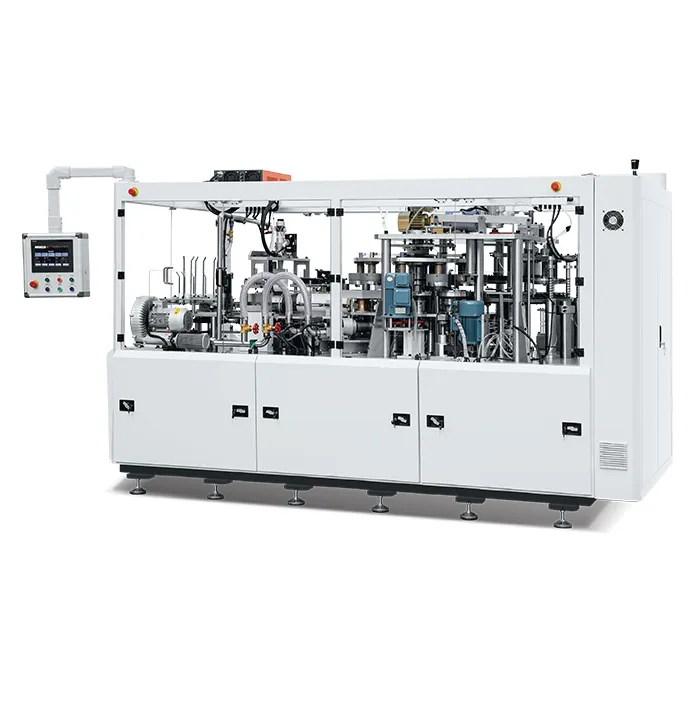
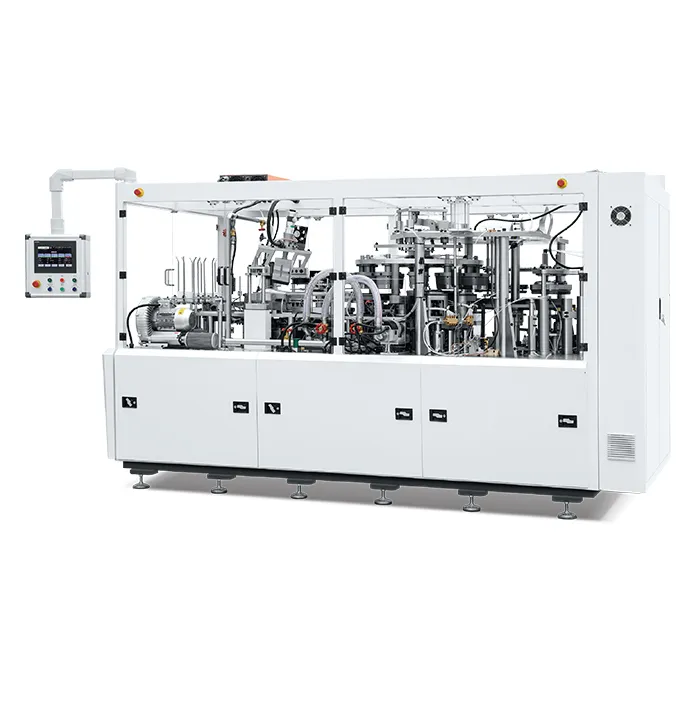
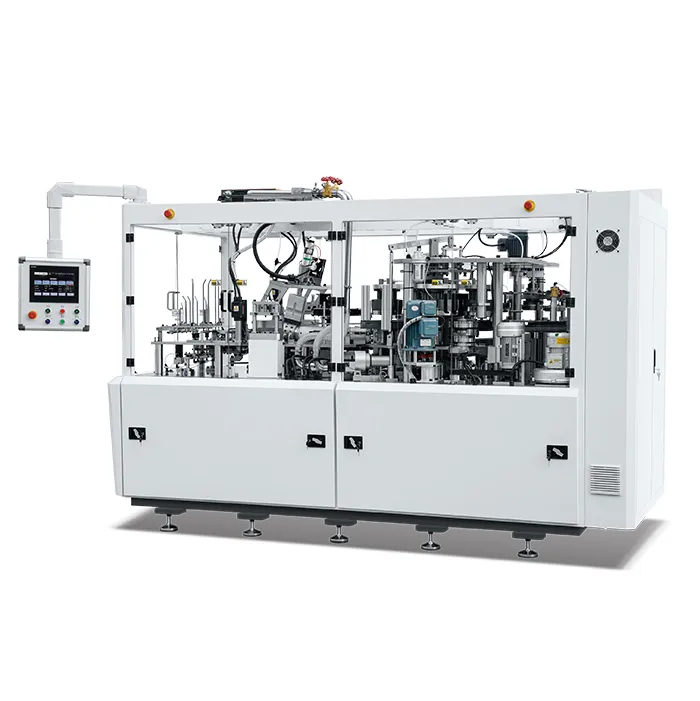
When evaluating a Paper Cup Machine for purchase, the first number most buyers look at is the rated speed – typically expressed in pieces per minute. But experienced production managers know that rated speed and real daily output are two very different things. A machine rated at 100 pcs/min may only deliver 70% of that in continuous operation, while another rated at 80 pcs/min could outperform it over a full shift. The gap comes down to several interconnected factors that affect how fast a cup forming machine can consistently run without compromising cup quality or causing downtime.
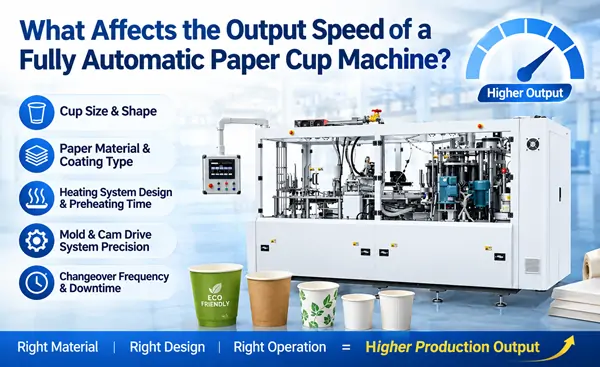
1. Cup Size and Shape
This is the most direct influence on output speed. Smaller cups – such as 4oz espresso cups – require less material per piece and less heating time, so the machine can cycle faster. Larger cups, especially those above 16oz, need longer sealing time at the side seam and bottom, which naturally slows the cycle.
According to the specification ranges shown on the DISCOVER product page, machines in the same series can handle sizes from 2oz to 24oz depending on the model. The same machine running 8oz cups typically produces more pieces per minute than when running 22oz cups. Non-round shapes – such as square or oval containers – further reduce output because the forming and sealing process involves more complex movements.
Key point: When comparing machines, always ask for the speed at your specific cup size, not just the maximum speed at the smallest size the machine can run.
2. Paper Material and Coating Type
The weight and coating of the paper directly affect how fast a cup forming machine can operate. Heavier paper – for example, 300-350 gsm compared to 210 gsm – requires longer heating time because the PE or PLA coating must reach the right temperature to bond properly. Too fast a cycle, and the bottom seal may fail.
The machine specifications on the DISCOVER page indicate a paper weight range of 210-350 gsm for most models. Within this range, operators may need to adjust the machine speed downward when running heavier stock.
PLA-coated paper, increasingly used for biodegradable cups, has a narrower sealing temperature window than traditional PE. This can require slower cycling or more precise temperature control to maintain consistent seal quality.
3. Heating System Design and Preheating Time
The heating system is often the bottleneck that determines cycle time. Most modern cup forming machines use bottom heaters – the DISCOVER advantages mention Leister heaters with ±1℃ temperature control accuracy and preheating time reduced to 90 seconds. The faster and more uniform the heating, the quicker the machine can complete each sealing cycle without risking weak seals.
Inadequate preheating leads to poor bonding at the cup bottom – a direct cause of leaking cups. Operators sometimes compensate by slowing down the machine to allow more heat transfer time. A well-designed heating system with quick preheating capability helps the machine run closer to its rated speed for a wider range of paper types.
4. Mold and Cam Drive System Precision
The mechanical drive system determines how smoothly the machine can run at high speed without vibration or misalignment. The DISCOVER advantages highlight an open type cam drive system with double longitudinal axis, specifying ±0.005mm positioning accuracy and heat sealing cup synchronization deviation under 0.1 seconds.
At higher speeds, even small positioning errors compound. If the cup body and bottom mold don't align perfectly, the machine may produce defective cups and need to slow down. A precision cam drive system allows the machine to maintain higher consistent speeds with fewer rejects.
5. Changeover Frequency and Downtime
Average output over a shift is not the same as instantaneous speed. Frequent size or pattern changes eat into productive time. If a machine takes 30 minutes to switch from one cup size to another and this happens twice a day, an hour of production is lost regardless of how fast the machine runs when it's actually making cups.
The DISCOVER FAQ section mentions that changeover time for their automatic machines typically ranges from 15 to 30 minutes, achieved through modular tooling design. Machines with quicker changeover capability preserve more of their theoretical output across a shift.
Factors at a Glance
| Factor |
How It Affects Output Speed |
| Cup size |
Larger cups need longer sealing time, reducing pcs/min |
| Cup shape |
Non-round shapes require more complex forming steps |
| Paper weight (gsm) |
Heavier paper needs more heating time per cycle |
| Coating type |
PLA has narrower sealing window than PE |
| Heating system quality |
Faster, more uniform heating allows higher cycle speed |
| Cam drive precision |
Better alignment = fewer rejects at high speed |
| Changeover time |
Longer changeovers reduce net daily output |
How to Estimate Real Daily Output
Rather than relying solely on the rated speed, consider this practical approach:
• Start with the rated speed for your target cup size and paper weight.
• Deduct 5-15% for the gap between theoretical and sustained running speed.
• Multiply by the actual running hours per shift (excluding changeovers, breaks, and maintenance).
• Account for a small reject rate based on your quality requirements.
Actual output can only be confirmed through a trial with your own materials and cup specifications. Buyers are encouraged to arrange sample production testing before finalizing equipment selection.
Frequently Asked Questions
Q: Why does my machine run slower with thicker paper?
A: Thicker paper (higher gsm) requires more heat energy to melt the PE or PLA coating properly. The heating system needs longer dwell time per cup to achieve a strong seal, which reduces the cycling speed. This is a physical limitation, not a machine defect.
Q: Can I run a paper cup machine at its maximum rated speed continuously?
A: Rated speed is typically measured under optimal conditions – a specific cup size, paper weight, and controlled environment. Continuous operation speed is usually 85-95% of the rated speed to maintain consistent cup quality and reduce wear on moving parts.
Q: How much does cup size affect daily production capacity?
A: A machine that produces 160 pcs/min for 4oz cups might produce only 100-120 pcs/min for 16oz cups. Over an 8-hour shift, this difference can amount to tens of thousands of cups. Always specify the target cup size when requesting production estimates.
Q: Does PLA-coated paper always slow down the machine?
A: Not necessarily, but PLA has a narrower optimal sealing temperature range compared to PE. This often means the machine needs to run at a slightly slower speed or with more precise temperature control to avoid weak seals. The actual impact depends on the specific PLA-coated paper and machine heating system quality.
Q: What's the fastest way to increase output without buying a new machine?
A: Reducing changeover time and unscheduled downtime often has the biggest immediate impact. Quick-change tooling, operator training, and a preventive maintenance schedule help the machine run more minutes per shift, which can increase daily output more than trying to push the speed beyond its comfortable limit. If you're also experiencing quality issues like leaking cups while trying to speed up, read our guide on bottom sealing troubleshooting.
Conclusion
The output speed of a fully automatic cup forming machine is not a single number – it's the result of cup size, paper material, heating system capability, mechanical precision, and how the machine is operated across a shift. The most useful metric is not the maximum rated speed but the sustained output for your specific cup type and production schedule.
To see how different machine models perform across cup sizes and paper types, you can review the available configurations. If you'd like to discuss your specific production requirements, contact DISCOVER to request a sample run with your own materials.

 English
 Pусский
 عربي
عربي