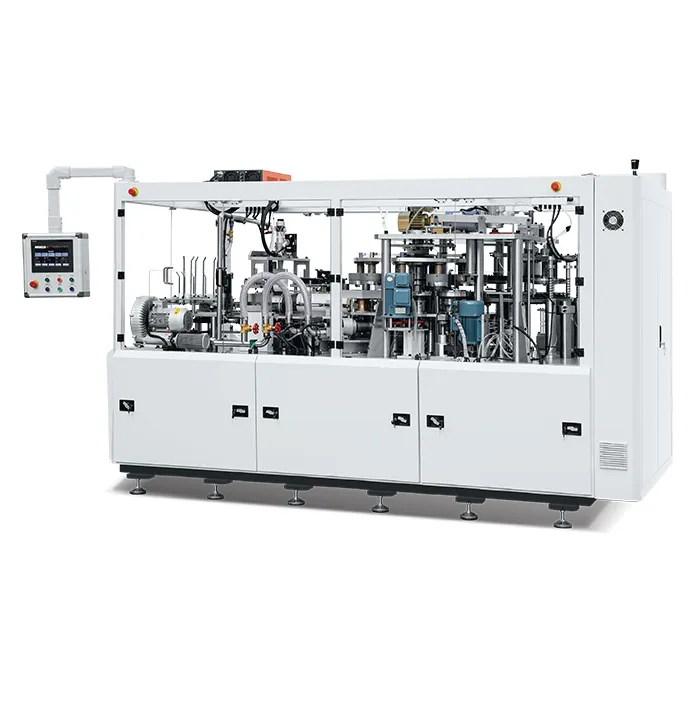
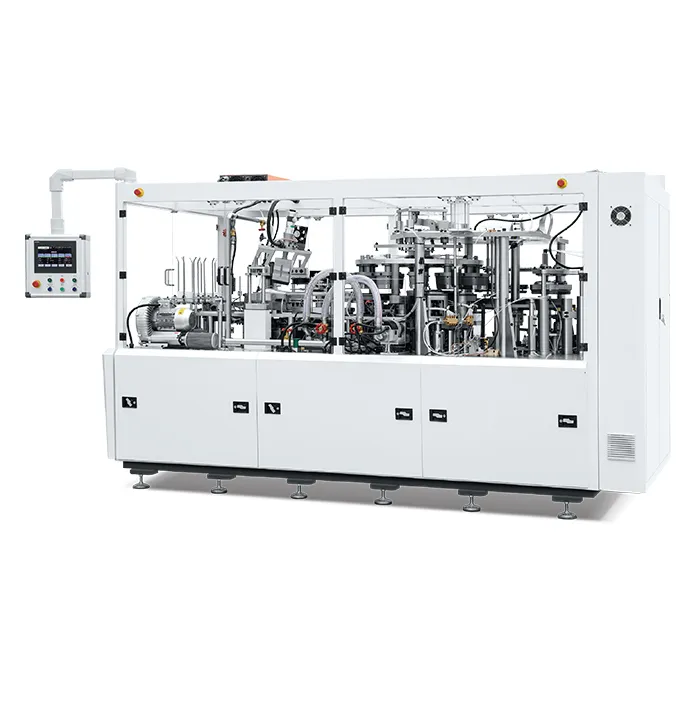
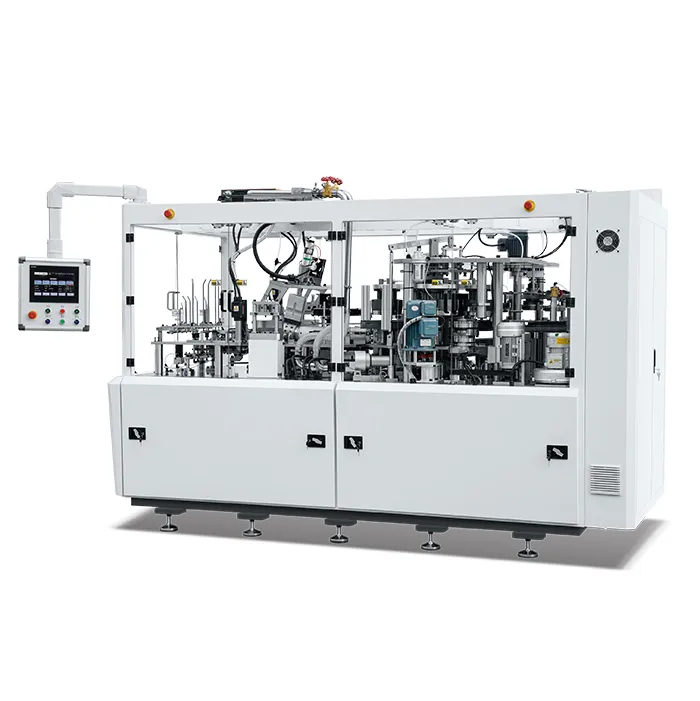
Noise and vibration in paper cup production are often treated as unavoidable operating conditions. In reality, both are measurable indicators of equipment condition, and excessive levels can affect operator health, product quality, and machine lifespan. This article explains the common sources of noise and vibration, the relevant health and safety standards, and practical methods to reduce both.
Before reviewing the specific sources and solutions, it helps to understand the equipment configuration on your production line. You can review the paper cup machine category for general equipment reference.
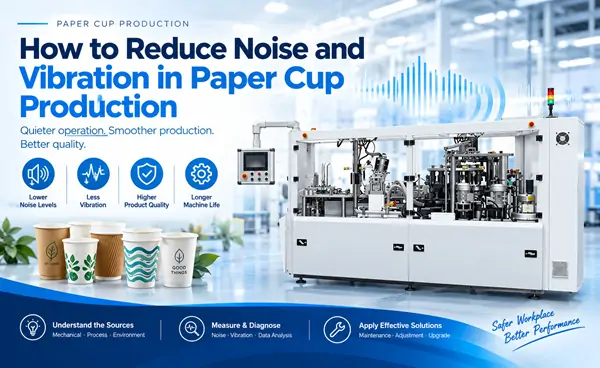
Why Noise and Vibration Matter
Noise and vibration are not just comfort issues. They have measurable consequences in three areas.
Operator Health and Regulatory Compliance
The U.S. Occupational Safety and Health Administration (OSHA) sets an action level of 85 dBA for an 8-hour exposure. When workers are exposed at or above this level, employers must institute a hearing conservation program. The permissible exposure limit is 90 dBA for an 8-hour time-weighted average. Factories operating multiple cup forming machines in the same area may exceed these thresholds without realizing it.
Product Quality
Vibration during forming affects dimensional accuracy. High-speed operation increases contact force in the cam mechanism, producing more vibration. Research on paper-cup-forming machine structures has shown that a redesigned upper plate reduced maximum deflection by 72% and maximum vibration by 38%, suggesting that structural vibration directly affects forming precision. Cups produced under high-vibration conditions are more likely to show inconsistent wall thickness, rim deformation, or sealing defects. Buyers evaluating new equipment should compare the equipment specifications of different models, including structural design and drive type.
Equipment Lifespan
Vibration accelerates wear on bearings, cams, and gears. When vibration levels rise above normal baselines, it typically indicates developing mechanical problems such as bearing degradation or component misalignment. Ignoring these indicators leads to premature component failure and unplanned downtime.
Common Sources of Noise and Vibration
Mechanical Sources
- Cam mechanism: The barrel cam or cylindrical cam that drives the forming stations is a primary vibration source at high speed. As production speed increases, contact force in the cam increases, producing more vibration.
- Gear transmission: Worn or misaligned gears generate impact noise during engagement.
- Bearings: Degraded bearings produce both vibration and high-frequency noise.
- Loose fasteners: Bolts and screws that have loosened from normal operation cause rattling and increase vibration.
Process Sources
- Paper feeding: Uneven paper thickness or misaligned feed rollers cause intermittent jamming and impact noise.
- Cutting and punching: The bottom punching station generates impact noise with each cycle.
- Sealing station: The opening and closing of sealing jaws creates repeated impact.
Environmental Sources
- Foundation condition: A machine placed on an uneven or insufficiently rigid floor transmits vibration more readily.
- Adjacent equipment: Other machines in the same area can contribute to the overall noise and vibration environment.
Measurement and Diagnosis
Before applying solutions, identify the specific sources.
Noise Measurement
Use a sound level meter to measure noise at operator positions during normal production. Compare readings against the OSHA action level of 85 dBA. For a more detailed analysis, use a frequency analyzer to identify whether the dominant noise is low-frequency (mechanical) or high-frequency (impact).
Vibration Measurement
Vibration can be measured using accelerometers mounted on the main drive shaft or bearing housings. Academic research on paper cup forming machines has developed fault diagnosis systems based on acceleration signal spectrum analysis, monitoring three key failure targets: paper deviation, temperature failure, and abnormal vibration.
Industry guidance suggests paying attention to vibration readings exceeding 4 mm/s RMS. A rapid increase above 7 mm/s typically indicates the onset of bearing degradation. Baseline readings, acceptable vibration ranges, and air consumption figures for specific models are listed in the technical documentation.
Solutions: From Simple to Comprehensive
Level 1: Maintenance-Based Solutions
These require no additional investment and should be implemented first.
- Tighten all fasteners: Loose bolts and screws are a common and easily corrected source of noise and vibration. Conduct routine inspections to tighten loose bolts and fasteners.
- Lubricate moving parts: Proper lubrication reduces friction between parts, reduces wear, and reduces noise during operation. Chains, gears, and sliding guides all require regular lubrication according to the machine manual.
- Check alignment: Misaligned components create additional noise and cause uneven wear. Verify that feed rollers, guide rails, and cam followers are properly aligned.
- Replace worn components: Old bearings and gears with worn surfaces are noisier than new ones. Upgrading to high-quality replacements can reduce noise levels.
Level 2: Vibration Isolation
These measures address vibration transmission from the machine to the floor and surrounding structure.
- Vibration isolation mounts: Use isolation mounts or pads between the machine base and the floor to reduce transmission of vibrations to the floor or support structure.
- Level and stabilize the machine: Ensure the machine is placed on a flat, stable surface to prevent instability. Uneven placement increases vibration.
- Foundation reinforcement: If the floor lacks sufficient rigidity, a reinforced foundation pad may be needed.
Level 3: Acoustic Treatments
These measures address noise in the workspace.
- Acoustic panels: Install acoustic panels or foam around the machine to absorb sound. This can help reduce the overall noise level in the vicinity of the machine.
- Soundproof enclosures: Build or install soundproof enclosures or covers around the machine to contain and reduce noise. Ensure proper ventilation to prevent overheating.
- Noise barriers: Construct barriers or partitions around the machine to block or deflect noise away from work areas.
Level 4: Design and Equipment Selection
When planning new equipment or upgrades, design choices can reduce noise and vibration from the source.
- Servo-driven systems: Servo motor control eliminates complex cams, gears, and chains, reducing mechanical wear and noise. Reported noise levels for servo-driven paper cup machines are typically ≤75 dB.
- Optimized cam profiles: Research on barrel cam optimization has shown that modifying the cam profile using multibody dynamics models can reduce vibration while maintaining production speed.
- Structural improvements: A redesigned upper plate reduced maximum vibration by 38% in simulation studies, demonstrating that structural design directly affects vibration levels.
Comparison of Noise and Vibration Control Methods
| Method |
Investment level |
Effectiveness |
Best for |
| Tighten fasteners and lubricate |
Low |
Moderate |
All machines; first step |
| Replace worn bearings and gears |
Medium |
Moderate to high |
Machines with rising noise over time |
| Vibration isolation mounts |
Low to medium |
Moderate |
Reducing floor transmission |
| Acoustic panels and enclosures |
Medium to high |
High |
Workspace noise reduction |
| Servo-driven equipment |
High (capital) |
High |
New installations or major upgrades |
| Cam profile optimization |
Design-level |
Moderate to high |
High-speed machine design |
Practical Checklist for Noise and Vibration Reduction
- Measure current noise levels at operator positions during normal production.
- Compare readings against OSHA action level of 85 dBA.
- Measure vibration on the main drive shaft and bearing housings.
- Check for loose fasteners and tighten as needed.
- Verify lubrication of chains, gears, and sliding guides.
- Inspect bearings for wear and replace if vibration exceeds 7 mm/s.
- Assess foundation rigidity and level condition.
- Apply vibration isolation mounts if floor transmission is significant.
- Consider acoustic panels or enclosures if workspace noise remains high.
- For new equipment, evaluate servo-driven options and structural design.
FAQ
What is the OSHA noise exposure limit for factory workers?
OSHA sets an action level of 85 dBA for an 8-hour exposure. When workers are exposed at or above this level, employers must implement a hearing conservation program. The permissible exposure limit is 90 dBA for an 8-hour time-weighted average.
What vibration level indicates a problem with the machine?
Vibration readings exceeding 4 mm/s RMS should be monitored. A rapid increase above 7 mm/s typically indicates the onset of bearing degradation and requires investigation.
Can vibration affect paper cup quality?
Yes. Vibration during forming affects dimensional accuracy. Research has shown that structural vibration directly affects forming precision, and cups produced under high-vibration conditions are more likely to show inconsistent wall thickness or sealing defects.
What is the easiest way to reduce noise immediately?
Tightening loose fasteners and lubricating moving parts are the simplest and most immediate measures. Loose components cause rattling, and dry moving parts generate friction noise. Both can be addressed during routine maintenance.
Do servo-driven paper cup machines produce less noise?
Servo-driven systems eliminate many mechanical transmission components such as cams, gears, and chains. Reported noise levels for servo-driven machines are typically ≤75 dB, which is below the OSHA action level.
How do I know if noise reduction measures are working?
Measure noise levels at operator positions before and after implementing changes. For vibration, monitor readings on the main drive shaft. A sustained reduction in both indicates the measures are effective. Document baseline and post-change measurements for comparison.
Conclusion
Noise and vibration in paper cup production are measurable conditions that affect operator health, product quality, and equipment lifespan. By understanding the common sources and applying a layered approach—from basic maintenance to isolation and acoustic treatments—factories can reduce both to acceptable levels. For specific equipment questions, review the available configurations or contact Discover to discuss your production requirements.

 English
 Pусский
 عربي
عربي