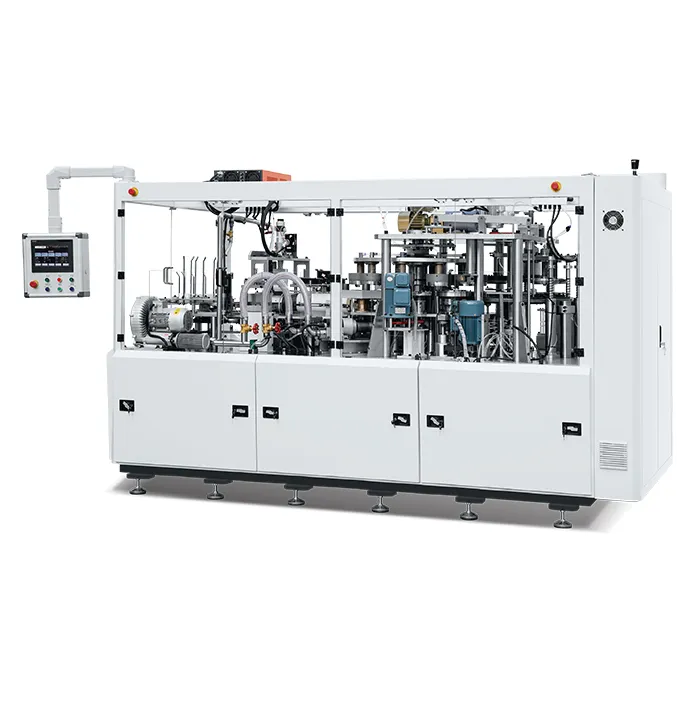
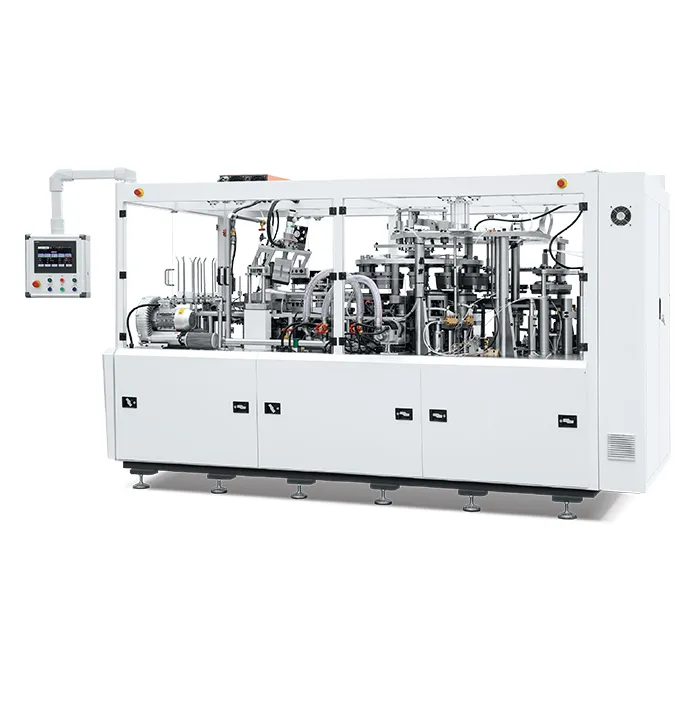
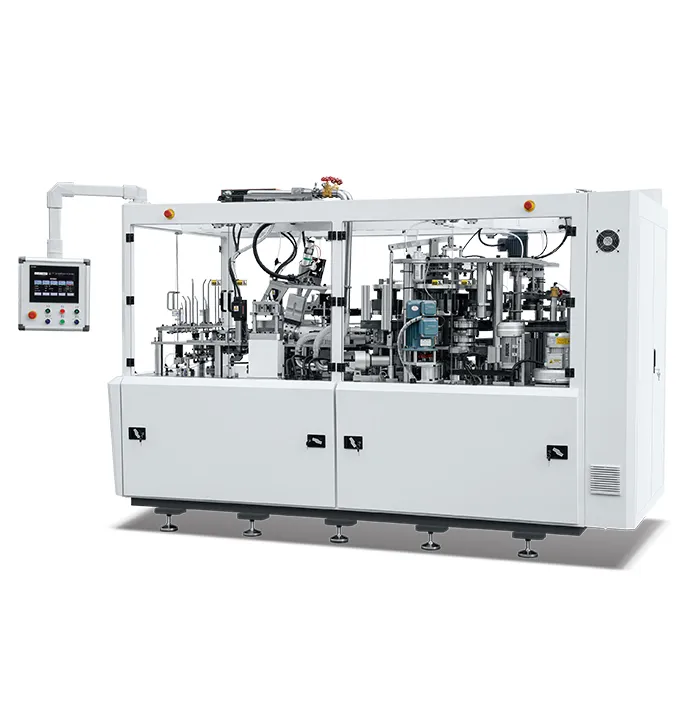
Tooling wear is one of the main reasons paper cup machines lose dimensional accuracy, develop sealing defects, and require frequent changeovers. When a cup leaks or its rim cracks, the root cause is often worn mandrels, punches, or curling dies rather than incorrect parameter settings. This article explains how tooling materials and surface treatments determine wear resistance, and how to evaluate these factors when purchasing or maintaining equipment.
Before diving into material science, it helps to understand the baseline specifications of the equipment. You can review the standard configurations on the paper cup machine category page.
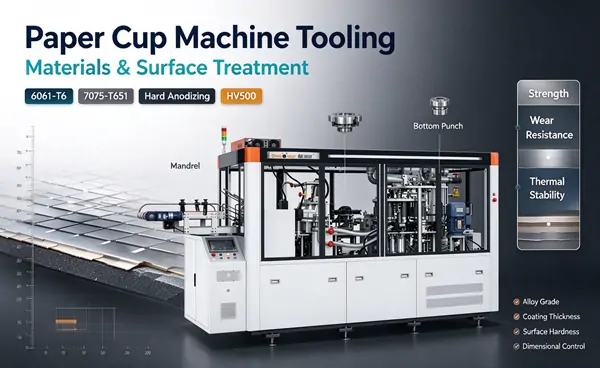
The Mechanical Demands on Cup Forming Tooling
Cup forming tooling—specifically the forming mandrel, bottom punch, and rim curling dies—operates under severe physical stress.
- High-speed impact: At speeds of 100 to 150 pieces per minute, the bottom punch repeatedly strikes the paper with significant force.
- Thermal cycling: Mandrels are continuously heated by contact with the sealing station and then cooled as the cup is ejected. This expansion and contraction can warp softer materials.
- Abrasive friction: Paper is an abrasive material. The continuous sliding of paper across the tooling surfaces gradually wears away the metal.
When the tooling surface wears down, the gap between the punch and die increases. This leads to insufficient pressure during bottom sealing, causing leaks, and improper shaping during rim curling, resulting in cracked or deformed rims.
Aluminum Alloys Used in Paper Cup Tooling
To balance weight, thermal conductivity, and machinability, cup forming tooling is typically machined from aluminum alloys. Two grades are commonly used in the industry:
6061-T6 Aluminum
6061-T6 is a general-purpose structural alloy. Its main alloying elements are magnesium and silicon. It is highly machinable, welds easily, and offers good corrosion resistance. In paper cup machines, 6061-T6 is often used for structural components, guide rails, and less critical forming parts. While it is relatively tough, it has lower yield strength and wear resistance compared to 7000-series alloys.
7075-T651 Aluminum
7075-T651 is a high-strength aerospace-grade alloy, with zinc as its primary alloying element. It offers significantly higher tensile strength and yield strength than 6061. When used for forming mandrels and punches, 7075-T651 holds its shape better under high pressure and resists deformation. However, it is more expensive and slightly less resistant to corrosion if not treated properly.
Why Use Both?
A well-engineered machine will match the material to the part's function. High-stress areas like bottom punches benefit from the strength of 7075-T651, while structural brackets and lower-wear guides may use 6061-T6 to manage cost and weight.
The Role of Surface Treatment: Hard Anodizing
The base aluminum alloy is only half the story. Aluminum, while strong, is relatively soft on the surface. Without treatment, paper dust would quickly polish away the tooling edges.
High-quality paper cup tooling undergoes hard anodizing treatment. This is an electrochemical process that converts the aluminum surface into a dense, extremely hard layer of aluminum oxide.
Key Technical Specifications
- Surface Hardness: A proper hard anodized layer can reach a surface hardness of approximately HV500 (Vickers hardness). This high hardness provides excellent wear resistance against abrasive paper.
- Thickness: The anodized layer is typically 25 to 250 microns thick. For forming tooling, a thicker coating provides a longer wear life but must be carefully controlled to avoid altering the precise dimensions of the tooling.
- Breakdown Voltage: A high-quality anodized layer can reach a breakdown voltage of 2000 volts, meaning it acts as a strong electrical insulator.
Why This Matters for Production
When a mandrel is hard-anodized to HV500, the surface resists the abrasive sliding of paper and the friction of the forming process. This significantly reduces the frequency of tooling replacement and maintains dimensional consistency over millions of cycles. If the anodized layer wears through, the softer aluminum underneath will wear rapidly, causing a sudden drop in cup quality.
How to Evaluate Tooling Quality Before Buying
When evaluating a new machine or ordering replacement tooling, buyers should ask the supplier specific questions about materials and processes. Reviewing the manufacturer's technological innovations can also provide insight into their manufacturing capabilities.
Questions to ask:
- Which alloy is used for the mandrels and punches? (Look for 7075-T651 in high-stress areas.)
- What is the thickness of the hard anodizing? (Typically 25-250 microns for durability.)
- What is the surface hardness of the anodized layer? (Should be around HV500.)
- Are the tooling dimensions guaranteed after the anodizing process? (The anodizing adds thickness; precision grinding must follow the process if tight tolerances are required.)
Signs That Tooling Needs Replacement
Even with the best materials, tooling eventually wears out. Look for these signs:
| Sign of wear |
Location |
Probable cause |
| Tearing at the bottom edge |
Bottom punch |
Dull cutting edge or chipped anodized layer |
| Inconsistent cup height |
Forming mandrel |
Wear on the mandrel base or vertical misalignment |
| Rim cracking |
Curling die |
Loss of surface smoothness or incorrect die profile |
| Sealing leaks |
Bottom sealing anvil |
Surface wear reducing pressure concentration |
FAQ
What is the difference between 6061-T6 and 7075-T651 aluminum?
6061-T6 is a standard structural alloy with magnesium and silicon, offering good machinability. 7075-T651 is a high-strength aerospace alloy with zinc, offering much higher yield strength and resistance to deformation under pressure.
What is hard anodizing on paper cup tooling?
It is an electrochemical process that creates a hard aluminum oxide layer on the tooling surface. This layer provides wear resistance against abrasive paper and helps maintain precise dimensions over time.
How hard is a hard anodized layer?
A high-quality hard anodized layer can reach a surface hardness of approximately HV500, with a typical thickness between 25 and 250 microns.
How do I know if my paper cup tooling is worn out?
Look for sudden increases in bottom leaks, rim cracking, or dimensional deviations. Visual inspection under light can reveal if the anodized layer has worn through, exposing the softer aluminum underneath.
Can worn tooling be repaired?
In some cases, tooling can be stripped, re-machined, and re-anodized. However, if the base dimensions or edges are severely damaged, replacement is usually more cost-effective than repair.
Why do some machines wear out tooling faster than others?
Wear is affected by paper abrasiveness (e.g., higher GSM or recycled fiber), machine speed, and the quality of the tooling material and anodizing thickness. Running the machine at maximum speed without proper lubrication also accelerates wear.
Conclusion
The lifespan of paper cup machine tooling depends on both the base alloy selected and the quality of the surface treatment. Using 6061-T6 for structural parts and 7075-T651 for high-stress forming parts, combined with thick, HV500 hard anodizing, provides a reliable balance of strength and wear resistance. To discuss specific tooling configurations or request material specifications for your next machine, contact Discover for technical details.

 English
 Pусский
 عربي