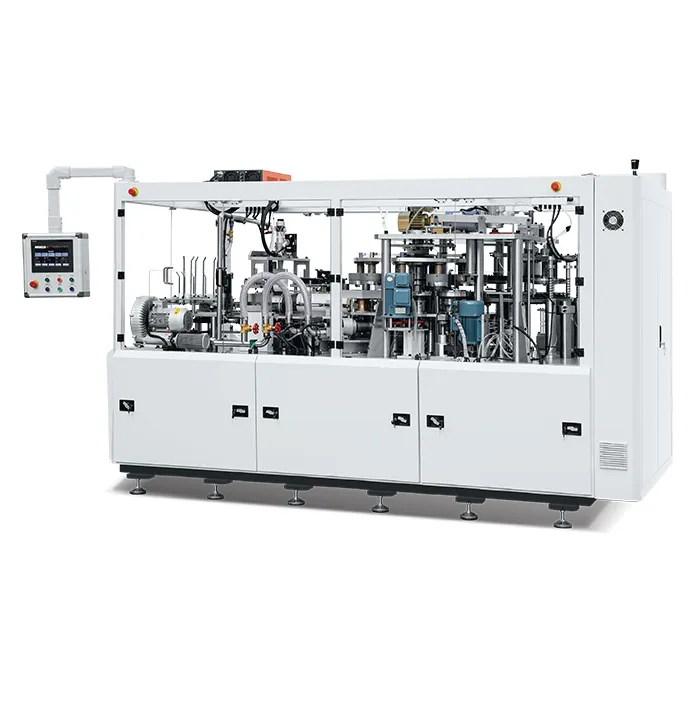
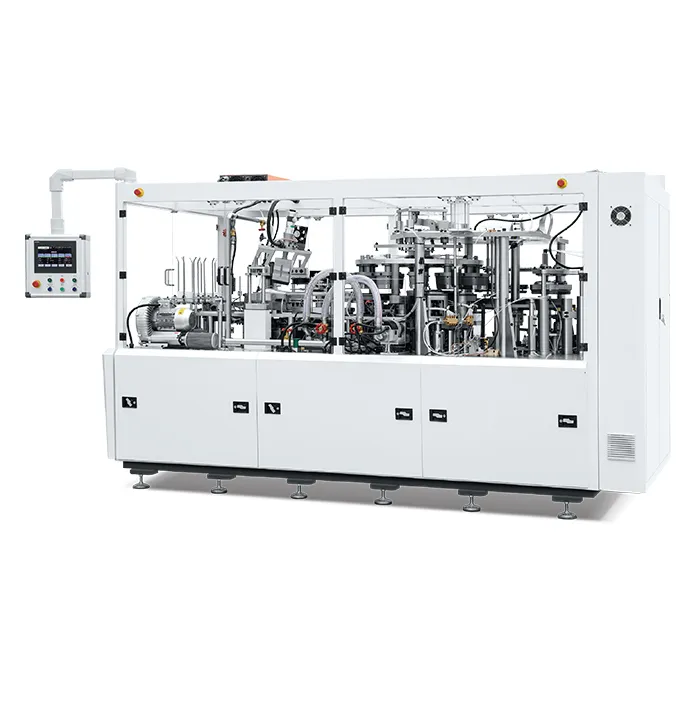
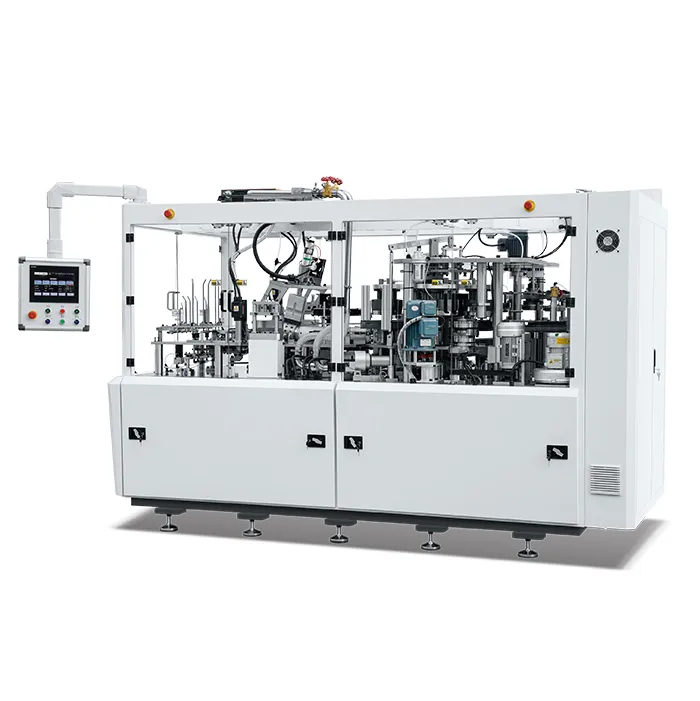
A small business owner once told me: “I bought my first cup machine based on price. Six months later, I had spent more on downtime and rejected cups than I saved on the purchase.” That story isn’t rare. In the disposable tableware industry, choosing the wrong equipment can trap you in a cycle of poor output quality, high waste, and frustrated operators.
So what actually matters when you’re evaluating cup forming equipment? After talking with production managers across five countries, I’ve distilled the selection process into five practical checkpoints. None of them are about brand glamour—they’re about what keeps your line running at target efficiency for years.
1. Output Speed vs. Your Real Demand Curve
Many buyers chase the highest speed number on the spec sheet. A machine rated at 250 cups per minute sounds impressive. But here’s the catch: that top speed usually applies to a specific cup size (often 8 oz) with standard paper weight. When you switch to a 16 oz cup or coated paperboard, the sustainable speed often drops by 25-30%.
What to do instead: Ask the supplier for a speed matrix showing output at three different cup sizes (small, medium, large) and two paper weights (standard and heavy). A transparent manufacturer will provide this data. Then compare it against your actual order mix. If 80% of your orders are 12 oz cups, optimize for that size’s real-world speed, not the theoretical peak.
Another overlooked factor: acceleration and deceleration time. Some machines take 45 seconds to reach full speed from a cold start and another 30 seconds to stop cleanly. Over hundreds of job changes per month, that wasted time adds up. Look for servo-driven systems that can ramp up in under 15 seconds.
2. Mold and Forming Station Durability
The heart of any cup forming system is the mold set. This is where the paper is shaped, sealed, and trimmed. Cheap molds use standard tool steel that may start showing wear after 5-8 million cycles. High-quality molds incorporate hardened steel (58-62 HRC) on critical sealing surfaces and can exceed 20 million cycles before requiring refurbishment.
According to a 2023 industry report by the International Association of Food Equipment Manufacturers (IAFEM), mold-related downtime accounts for nearly 40% of all unplanned stops in cup production lines. The symptoms: ragged cup rims, inconsistent bottom sealing, and gradual increase in paper dust accumulation inside the machine.
Key question to ask: “Can you show me a wear pattern chart for your molds at 10 million cycles?” A supplier with in-house heat treatment and CNC grinding will have this data. Also verify whether molds for different cup sizes (from 4 oz to 20 oz) share a common mounting interface. Interchangeable mold bases reduce changeover time from hours to minutes.
To see how a hardened mold system with quick-release design performs in real production, check the tooling specifications on DISCOVER’s cup forming line.
3. Heating System Efficiency & Temperature Stability
This is where many hidden costs live. The heating elements that seal the cup bottom and sidewall must maintain ±5°C accuracy across the entire sealing surface. If the temperature drifts, you get either weak seals (leaking cups) or burnt paper (customer complaints and health code risks).
Traditional heating systems use cartridge heaters controlled by simple on-off thermostats. They work but waste energy and have short lifespans (around 3,000-4,000 hours). Modern systems employ:
-
Multi-zone PID controllers that adjust power continuously
-
Ceramic heating elements with faster response and lower thermal mass
-
Insulated heating chambers that reduce heat loss to the environment
A practical benchmark: For a 6-station rotary cup machine running 16 hours a day, the difference between an inefficient heater (65% thermal efficiency) and an efficient one (85%) is roughly 12,000 kWh per year. At $0.12/kWh, that’s $1,440 annual savings. Over a 10-year lifespan, you’re looking at $14,400—enough to buy a small auxiliary unit.
But efficiency isn’t the only factor. Temperature recovery time matters during continuous operation. After each sealing cycle, the heating element loses some heat to the paper. A good PID controller restores set temperature within 2-3 seconds. A poor one might take 5-6 seconds, causing inconsistent seals on high-speed runs.
4. Automation Level: From Manual to Fully Integrated
Cup machines fall into three automation tiers:
| Automation Level |
Operator Actions |
Typical Output (cups/min) |
Best For |
| Manual |
Hand-feed paper, manual stack removal |
40-60 |
Small bakeries, startups |
| Semi-automatic |
Auto paper feed, manual quality inspection |
70-120 |
Medium volumes, varied sizes |
| Fully automatic |
Auto feed, inline leak test, stack counting, reject ejection |
150-250+ |
High-volume production, 24/7 operations |
The trap is buying a fully automatic machine when your order volume doesn’t justify it—or buying a manual machine when you plan to scale within 18 months. Rule of thumb: If you run more than two shifts or produce over 500,000 cups per month, you need automatic stack delivery and reject ejection. Otherwise, operator fatigue will cause quality slips after the fourth hour.
Also evaluate changeover automation. How many tools are needed to switch from a 9 oz to a 12 oz cup? Some machines require replacing 12 different parts and 30 minutes of adjustments. Others use a single lever to adjust the forming depth and a quick-change mold cassette—under 8 minutes. Ask for a video of a live changeover.
If you’re unsure which automation tier fits your production volume, use DISCOVER’s online selection guide to compare models.
5. Serviceability and Spare Parts Availability
This factor is rarely on the initial checklist but becomes critical after year two. Cup machines contain consumable parts: heating elements, timing belts, sensors, bearings, and sealing rings. The question isn’t whether they will fail—it’s how fast you can get replacements.
Red flags to watch for:
-
The supplier doesn’t publish a spare parts list with part numbers
-
Critical components (like the main controller board) are proprietary and require factory repair
-
The warranty excludes consumables that fail within the first 6 months
-
No local service partner within 200 km of your facility
Green flags:
-
Exploded-view diagrams available online for every assembly
-
Standard industrial components (Siemens PLC, SMC pneumatics, SKF bearings) that any local industrial supplier can cross-reference
-
A clear spare parts kit recommendation for first-year operation (typically 5% of machine cost)
-
Video tutorials for common repairs like belt tensioning or heater replacement
One experienced plant manager shared this tip: “When I evaluate a supplier, I ask for the phone number of a customer who bought the same model three years ago. Then I ask that customer two questions—’What broke?’ and ‘How long did it take to get the part?’ The answers tell me everything.”
A Quick Decision Matrix for Your Situation
| If your priority is… |
Focus on… |
Avoid machines that… |
| Lowest upfront cost |
Manual or semi-auto models with basic heating |
Claim “full auto” at suspiciously low price (hidden extras) |
| Highest output per hour |
Speed matrix for your main cup size + fast acceleration |
Only advertise peak speed on smallest cup |
| Long-term operating cost |
Heating efficiency + mold hardness (HRC) |
Use uncoated standard steel molds |
| Frequent size changes |
Quick-change mold system + single-lever depth adjustment |
Require tools for changeover |
| Minimal downtime |
Standard components + local service availability |
Have proprietary electronics |
Common Mistakes First-Time Buyers Make (Based on Real Feedback)
Through a survey of 45 cup machine users conducted by a German packaging blog last year, the top three regrets were:
-
Underestimating paper dust management – Some machines lack effective vacuum systems near cutting stations. Paper dust accumulates on sensors, causing false triggers. One user reported cleaning sensors twice per shift. Ask about the dust extraction design.
-
Ignoring floor space for downstream equipment – The machine itself might be compact, but where do you put the cup stacker, leak tester, and packaging table? Map the entire work cell.
-
Not testing with their own paper – Paper from different mills has different stiffness and coating properties. Always request a trial run using your actual paper stock. A machine that works perfectly with premium paper may struggle with economy grades.
Final Verdict: Match the Machine to Your Reality
The best cup forming equipment isn’t the most expensive or the fastest. It’s the one that aligns with your order volume, size mix, operator skill level, and service access. Treat the selection process as a three-step investigation: first, define your actual production profile (sizes, shifts, monthly volume). Second, request speed and wear data for your specific use case. Third, verify serviceability through customer references.
If you’re ready to see how a fully documented, service-friendly cup forming system fits into your line, request a customized performance simulation from DISCOVER’s team.
References & Notes
-
IAFEM 2023 downtime report – “Equipment Reliability in Disposable Food Packaging”. Available to members.
-
Heating efficiency benchmark based on typical 6-station rotary press at 120 cycles/min, 16-hour operation, 250 working days/year.
-
Survey of 45 cup machine users conducted by Packaging Insights (Germany), Q2 2024. Summary available upon request.
Disclaimer: Performance data provided as general guidance. Actual results depend on paper quality, operator training, and maintenance practices. Always conduct on-site trials before purchase.

 English
 Pусский
 عربي
عربي